for the latest
This page is for agents and other users of Attendant. If you're an administrator, see Attendant for Administrators.
Attendant is a tool for your Out of Office status in the phone system. It allows callers to be directed to a backup user or alternate phone number if you aren't available to take calls. Attendant allows you to use call forwarding and a corporate directory that callers can access to reach the person or department they need to talk to. It also provides voicemail management, if your organization uses this option.
Depending on how your organization has configured Attendant, you can:
- Change your status to Out of Office.
- Record your name and system greeting.
- Set a backup user to take your calls while you're out of office.
- Change how the system notifies you about new messages and missed calls.
- Manage your voicemail messages. You can listen, download, delete, send a copy to your email, and forward them to others in your organization.
- Access your voicemail messages by phone. If enabled, your administrator can provide instructions on how to access your voicemail.
Attendant refreshes automatically at regular intervals. Do not click Refresh in your browser as this can cause an error.
Admin User Tasks
Some of the tasks on this page are for users with administrator privileges. Admin users can:
-
Access other Attendant users' voicemail messages.
-
Impersonate another Attendant user.
-
Change another Attendant user's out of office message.
-
View users that current have the Out of Office status.
-
Generate a list of Attendant users.
Out of Office Status and Call Forwarding
If your administrator has enabled it, you can set your status to Out of Office. When this option is enabled, you can set your status to Out of Office indefinitely and then manually change your status back to In Office when you return. Or you can define a range of dates for your absence and your status will automatically change back to In Office at the end of that time.
When you change your status to Out of Office, you can choose another person as a backup to take your calls while you are away. All calls that come in for you during that time will be forwarded to the backup user. You can specify any user as your backup any time you change your status. A default may be already configured for you by your system administrator.
Call Rollover
Call rollover means that the system routes a call to a secondary phone number if the primary number wasn't answered. The secondary number could be a cell phone or a home phone, for example.
Call rollover must be configured by the administrator for each user before it will work. After your account has been configured for call rollover, calls will automatically roll over to the secondary number on your account if you don't answer the call at the primary number. You don't have to do anything in Attendant to make it work. If you have questions about whether you have call rollover, contact your system administrator.
Direct Transfers to Voicemail
Attendant supports transferring contacts directly to agent voicemail. This way, even if you're offline at the time, a contact can leave you a voicemail.
This option is for Attendant users who are also agents and use an Agent Workspace (Agent) application. Additionally, your Attendant administrator must enable this feature for you before you can use it. When enabled, other agents can transfer calls to your voicemail when you're offline.
User Impersonation
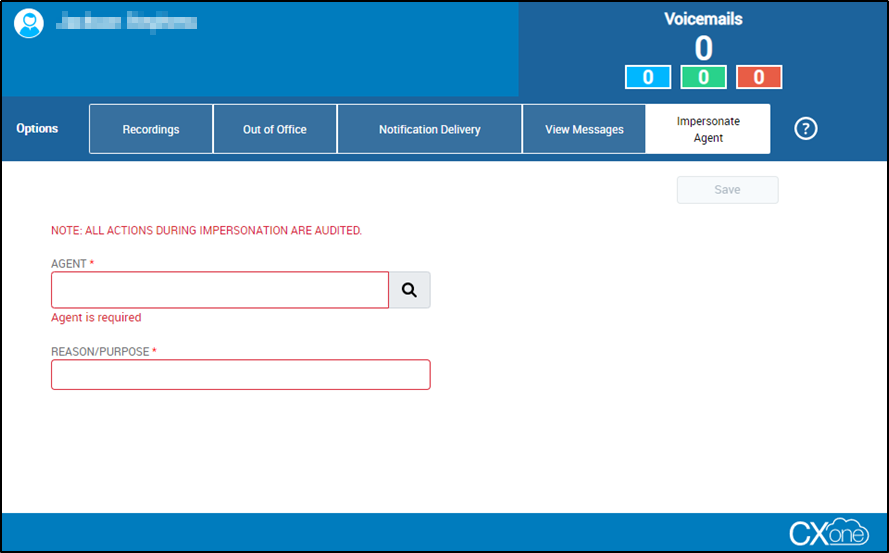
From time to time, an administrator may need to access the account of another Attendant user. For example, if an agent forgot to set their status to Out of Office before taking time off, an administrator can access their account to change it. This is called impersonation, and is an option only available to Attendant administrators.
When an administrator impersonates another user, they must provide a reason for doing it. The name of the impersonator and the user being impersonated are displayed on top of the screen. For auditing purposes, there is a recording of this in a log file.
 View image